Reliance Big TV has launched its Direct-to-Home (DTH) services on Tuesday.
Reliance Big TV is a wholly owned subsidiary of Reliance Communications, which has now entered in the home entertainment field.
The service would be available on the latest MPEG4 Direct-to-Home (DTH) platform with high picture quality.
Available in 6,500 towns, the DTH service will initially broadcast over 200 channels with digital quality picture and sound.
The CEO of Reliance Big TV, Arun Kapoor said the service will benefit more than 120 million TV households of India. The DTH service will enable users to view high quality pictures and other entertainment stuff. The introduction of DTH by reliance will further increase the competition in already existing media players. Tata Sky, Dish TV, Sun Direct and DD Direct are already providing DTH services in India.
The number of customers is expected to grow to 60 million by 2012. The company is expected to invest 40 per cent share of this market at the end of 12 months. Reliance has started a new call center to handle over 50,000 calls daily. It will provide services in 11 Indian regional languages. The company has equipped with itself to provide 15,000 connections daily within 48-72 hours. The company will sell set top box with Rs. 1490 with three months subscription offer.
Source: topnews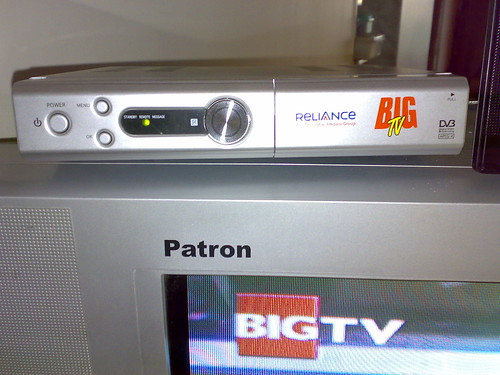
Thursday, 21 August 2008
Reliance Big TV launched

Tuesday, 22 July 2008
ESPN Star lands rights to Olympics
ESPN Star Sports has acquired exclusive cable, satellite, IPTV and mobile TV rights in 22 countries in Southeast Asia, including India, to the 2010 Vancouver Winter Olympics and the London 2012 Olympic Games.
Deal gives the Disney-News Corp. joint venture 200 hours of coverage for the London Games and more than 60 hours for Vancouver.
"This is the first time that IOC has awarded the rights to a pay TV platform across the region, and it is a testament to our commitment to reaching out to a wide audience base across Asia with the most interesting and compelling programming," said ESS managing director Manu Sawhney.
The 22 territories covered by the deal are Afghanistan, Bangladesh, Bhutan, Brunei, Cambodia, East Timor, India, Indonesia, Laos, Macau (English-language rights only), Malaysia, Maldives, Mongolia, Myanmar, Nepal, New Caledonia (English-language rights only), Pakistan, Papua New Guinea, Singapore, Sri Lanka, Thailand and Vietnam.
The company recently landed exclusive TV rights for the Indian subcontinent to soccer events including the 2010 FIFA World Cup and 2009 Confederations Cup.
Source: variety
Wednesday, 18 June 2008
UTStarcom wins SLT IPTV contract
UUTStarcom Inc. said Tuesday it has signed a new contract to supply its Internet protocol television equipment to Sri Lanka Telecom Public Ltd. Co.
The Alameda company's "multi-million dollar" agreement with Sri Lanka Telecom partner Just In Time Holdings Pvt. Ltd. will eventually support the delivery of voice, Internet, and television services to Sri Lanka Telecom's 1.3 million customers on the south Asian island.
The initial rollout of UTStarcom Inc. (NASDAQ: UTSI) equipment is designed to support about 100,000 subscribers over the next two years. It will also enable the company to provide video services to future subscribers over copper lines in the next three to four years, it said.
Source: bizjournals
UTStarcom
Fortune 1000 company that specializes in IP-based networking products for telecommunications companies and service providers. Its core markets are multimedia communications and broadband, including IP communications and entertainment (IPTV), next generation broadband networks and optical network solutions. It also sells handsets and other consumer products including DSL modems and voice over IP terminal adapters. It has a large customer base in Asia, particularly in China, where it manufactures the majority of its products and where most of its employees are located. It also has business operations in the United States, India and Japan as well as research and design operations in the United States, China, Korea and India.
History of UTStarcom
The company was founded in 1991 by Lu, a China-born, US-educated entrepreneur, as Unitech Telecom. In its early years, the company was focused on the telecommunications markets in China. In 1995, Unitech merged with Starcom Networks to form UTStarcom. After several years of trying to build its business in China, UTStarcom launched the Personal Handy-phone System (PHS), also known as the Personal Access System. PHS is a scaled-down version of a cellular network and has 56 million subscribers in China. UTStarcom went public in March 2000. The IPO and a series of acquisitions helped the company expand its business and technology beyond its base in China to other emerging economies in Asia and Latin America as well as to Japan, the United States and Europe. Acquisitions Between 2002 and 2004, UTStarcom acquired several companies to expand its technology portfolio and market opportunities in areas such as handsets, CDMA technology, broadband and IP-based communications.
wiki
google
Stock is doing well this year
Stock up 100%
Note: i do not own UTStarcom(NASDAQ:UTSI) or SLT(COL:SLTL) shares
Monday, 7 April 2008
Reliance Communications makes Sri Lanka foray
Reliance Communications (RCom) in its effort to enter the Sri Lankan telecom market has formed a JV, named Reliance Mobile Lanka with a local firm, Electroteks which will begin GSM mobile services in Sri Lanka followed by other telecom services by this year.
RCom will reportedly invest Rs 1200 crore in the JV in the next three years to establish a next generation integrated network.
The new venture is expected to establish a network of about 5 million lines covering nearly 40 percent of the population.
Source:telecomtiger.com
Saturday, 5 April 2008
NewsX to be available on Tata Sky from April 14
NewsX, the recently launched English News channel from the house of INX Media, will be available on the DTH platform Tata Sky from April 14.
Indrani Mukerjea, Chairperson, INX News, said, "NewsX aims to redefine TV news in India with the best news team working to deliver the highest quality of content and style in keeping with the channel's promise of Clarity in a Complex World."
Vikram Kaushik, Managing director and CEO, Tata Sky said, "We have always been at the forefront in providing world class news and entertainment and other programming to its subscribers. We are delighted to add NewsX to our platform. This will further enhance our strong bouquet for its huge community of satisfied TV viewers across the country."
NewsX, India's first HDTV-ready news channel, is the first news channel in the Asia Pacific region to use high definition cameras on the road, offering better looking footage with sharper image quality.
Source: televisionpoint.com
Thursday, 27 March 2008
Multivision allowed to transmit
Sandasen Marasinghe
Colombo District Judge Sisira Ratnayake yesterday issued an enjoining order preventing Union Residencies (Pvt) Ltd from taking measures not to allow the Ruhunu 2001 Multivision (Pvt) Ltd to use the satellite dishes on the rooftop of the Union Residencies (Pvt) Ltd for their transmission.
The plaintiff Ruhunu 2001 Multivision (Pvt) Ltd filing the plaint before the District Court stated that it was using the two existing satellite dishes on the rooftop of the Union Residencies (Pvt) Ltd to operate their pay TV Service and Cable TV network.
The plaintiff stated that it entered into an agreement with the defendant company on November 24, 1997 to use the two existing satellites on the rooftop of the defendant company for 20 years to broadcast and transmit the plaintiff's services.
Plaintiff further submitted that the defendant later informed the plaintiff that they were unable to supply the services to the Ruhunu 2001 Multivision (Pvt) Ltd. The plaintiff further stated that the Ruhunu 2001 Multivision (Pvt) Ltd was incorporated as a joint venture between an Australian Company and Southern Development Authority to set up and operate a pay Cable Network in Sri Lanka.
The Government owns a 10 per cent share in the Ruhunu 2001 Multivision (Pvt) Ltd through the Southern Development Authority.
The Plaintiff evaluated the case for Rs. one million.
Source: dailynews
Saturday, 22 March 2008
Tata Sky changes ad-revenue model
The advertisement revenue model on the direct to home (DTH) platform is changing in the country. Tata Sky, which has 1.8 million subscribers and claims to offer the largest amount of interactive content among the DTH players in the Indian market, has moved on to a new ad-revenue earning model. It is making a shift from the ‘flat fee’ model to the ‘cash per lead’ model for advertisements, which in simple words mean that while advertisers used to pay a flat amount for their ads for a specific duration, say Rs 10 lakh for 10 days, to get their ad beamed on the platform, now they will pay for the number of consumers who have shown interest in their products.
Companies like Samsung, Whirlpool, Tata Teleservices have already opted for the cash per lead model where details of their product are beamed for Tata Sky customers in form of two to three static pages and if the consumer is interested in the product, he/she is asked to send an SMS back to a number. For every such SMS generated, Tata Sky is charging the advertiser.
“We have introduced this new ‘cash per lead’ model on our interactive platform in January 2008. The core strength of this model is that the advertiser doesn’t witness any wastage. This model closes the loop as advertisers end up paying for only those customers who have evinced genuine interest in their product. It also drastically reduces their cost on advertisement,” Vikram Mehra, CMO, Tata Sky told FE. Tata Sky is in talks with segments like car manufacturers, telecom operators, mutual funds, insurance products and personal computer who have shown keen interest in the new model.
“Basically all products which have to communicate in greater details to the consumer will tremendously benefit from this model. Today, Tata Sky caters to 91% of DTH subscribers in Sec A and Sec B cities. That is the target audience for many niche products. Since the concept of cash per lead is new, the ad space buyers are also trying to understand it. But the response so far has been very encouraging.” Currently these ads are in form of static pages but Tata Sky plans to offer space for video ads in near future.
Source: financialexpress.com
Friday, 21 March 2008
India set to relax limits on foreign DHT ownership
The regulator TRAI has recently suggested that India should relax its tough limits on foreign ownership and inward investment into DTH broadcasting.
At present foreign investors are limited to owning just 49% of an investment in DTH broadcasting, pay-TV operations and teleport Earth stations.
In an unprecedented move reports from New Delhi have stated that these limits are set to be raised to 74%. This limit is also set to apply to satellite radio operators. This could potentially help WorldSpace to expand its presence in India.
Nonetheless cable TV foreign ownership limits will stick at 49%. This has incensed that sector who wanted limits to raise to 74% on par with telecoms companies. Foreign ownership of Indian news and current affairs TV channels is set to stay at an even lower 26%.
Source: techwatch.co.uk
Anil Ambani group to launch 20 TV channels
The Reliance Dhirubhai Ambani Group is set to launch 20 TV channels in the country as part of its plans to expand the reach in the fast-growing broadcast entertainment business, top company officials said.
The group, which has Reliance Entertainment as a subsidiary, is foraying into the broadcast business through two companies Reliance Big TV Entertainment and Reliance Big TV News, the officials added.
"We are at the planning stage. So we are not revealing the details of the media project right now. At the appropriate time - very shortly perhaps - we will make a formal announcement," a spokesperson for the group told IANS.
"The first of these channels will go on air probably in July-August this year. We have already applied for approval of these channels from the information and broadcasting ministry," the spokesperson added.
Two separate companies are being floated since the government imposes restrictions on foreign direct investment in the news media sector and the group is proposing two general news and two business news channels in Hindi and English.
The group wants to remain open to the idea of roping in an international player in the entertainment TV segment, officials explained.
Although the other 16 channels have not yet been finalised, the idea is for two TV channels catering to Hindi entertainment and regional movies. Besides, plans also include channels for children and on lifestyle and leisure.
The Rs.130-billion Reliance Entertainment Ltd has interests in the production, distribution and exhibition of films, besides foraying into FM radio, Internet and television content.
The Reliance Anil Dhirubhai Ambani Group, through its subsidiaries, also has equity stakes in a number of media and entertainment companies. The group also markets music and movies under the labels of Big Music and Big Flicks.
In 2005, the group had also acquired Adlabs Films, which is among the largest entertainment companies in India with interests in film processing, production, exhibition and digital cinema. Through it, the company has forayed into FM radio under the Big 927 FM banner and has licences for 45 stations.
It already runs 12 stations across the country with more planned in the ensuing months.
Source: NDTV
Thursday, 20 March 2008
DishTV now in cars
Direct-to-home (DTH) major Dish TV has rolled out its on-the-move services in Kolkata, after Delhi and Mumbai.
The aim is to tap the niche, upwardly mobile consumers who could watch television while moving in a car, bus, aeroplane or train.
According to Ramesh Balinga, regional sales manager of Dish TV, “This service will be available for Rs 1,60,000, with a monthly subscription of Rs 300.”
For usage in cars, a set-top-box will be installed along with an antenna on the car. The six-inch thick antenna, instead of sticking out, will be a flat lying plate on the car. It will constantly move to align itself with the satellite.
Currently, Dish TV has a subscriber base of 1.7 lakh in West Bengal and 28 lakhs in the country.
Source: business-standard.com
Neo Sports spices up cricket
Neo Sports is poised to narrow the bridge between cricket and entertainment by announcing a bouquet of cricket based shows. These shows will commence with the upcoming India versus South Africa three-Test series, starting in Chennai on March 26.
The shows would be launched over the next one month with the first show going on air on Monday, March 24.Neo Sports will air shows that will engage the viewer on a larger level with the sport.
Dial C for Cricket a unique viewer centric interactive show, where viewers can call in to discuss the various issues of the game, player performances, match conditions etc. This show has been inspired by the blogging culture which exists and will be positioned as Your cricket blog on TV. Viewers can call to take part in various topics of discussion on cricket or ask questions about their favourite cricketer or the sport and get their queries answered by the panel of experts on board.
Baat and Bowl which would be hosted by Vineet Malhotra would take viewers up-close and personal with their cricket idols. The show would have informal interviews with the stalwarts of the game, off the field and in the studio. Sports Zone gives viewers their daily dose of sports updates. Everything that's happening around the globe in sport can be caught on this show.
Besides these shows Neo Sports has also woven the lighter side of the sport into the shows. Popular Neo Sports anchor Archana Vijaya would bring to the fore the fun aspect of the game and also give viewers a sneak peek into behind the scenes happenings of the teams. Tour Diary will see Archana following the teams at different venues across the country and cover the excitement at the stadiums, her interactions with cricketers, fans etc.
Cricket Tadka Marke as the name suggest would dish out the sport with a dash of spice. This show focuses on crazy fans, gossip about cricketers, fun trivia and other happenings in the world of cricket. The Cricket-Bollywood connection would be exposed here.
Then there are shows for the true cricket fanatic bringing those glorious old days of the past right into his living room. Encounter as the same suggests is about the greatest encounters in the history of cricket. These are classic matches, threaded with a theme, filled with insights, dramatizations, and anecdotes and behind the scenes drama. Each match is treated like a real story -- with a beginning middle and an end punctuated with its dramatic twists and turns along the way that ends in an exciting finish.
Ballebaaz showcases the best performances of Indian batsmen peppered with a unique filmy twist. The spotlight is on a great performance by a different batsman each week. Catch Dhoni's [Images] Dhamakas, Ganguly's Dadagiri, the Sabse Bada Khiladi- Sachin, Yuvi- The prince and Dravid-The Wall only on Ballebaaz.
Extra Cover will give an insight on the finer nuances of the game as well cover the fun aspect of it. It would encapsulate all aspects of the sport, from comprehensive cricket analysis and news, to lighter behind the scenes stories. The studio segment of Extra Cover will give viewers the latest updates, previews, reviews, statistics and expert opinions. Indian Test cricket legend Mohinder Amarnath and former South African Test cricketer Peter Kirsten would also be part of the show as guest panelist for the upcoming series against South Africa.
The news shows launched are:
1. Dial C for Cricket
2. Sports Zone
3. Tour Diary
4. Tadka Marke
5. Baat and Bowl
6. Encounter
7. Ballebaaz
8. Jaya He
9. The Great Indian Run Chase
Source: rediff.com
Sri Lanka's Caribbean tour live on Ten Sports
A young Sri Lankan side, led by the vastly experienced Mahela Jayawardene, will be hoping to make all the right moves against hosts West Indies during their two-Test matches and three ODI tour of the Caribbean Islands starting this month.
And Ten Sports, the most watched sports channel in the Sub-continent, will be present at each and every spectacular venue to ensure ball-by-ball coverage of what promises to be an intriguing series for both teams. Sri Lanka are hoping for a clean sweep to get over the disappointment of their tour Down Under, while the West Indies will be eager to build up on their good show in South Africa.
The first of the two Test matches start at Providence from Saturday, March 22, while the second Test is at Port of Spain from Thursday, April 3. The first two ODIs are at Port of Spain on 10 and 12 April, and the final ODI will be a day-night affair in St Lucia on 15 April.
Live telecast of the first Test match starts every day at 7:15 pm IST.
Sri Lanka lost both their last two tours of the West Indies, but with a much more experienced and varied bowling attack than the hosts this time – led by world record holder off spinner Muttiah Muralitharan and veteran seamer Chaminda Vaas – the visitors will be hoping for a first tour win in the Caribbean.
Sri Lanka will also be delighted with the batting form of skipper Jayawardene and Kumar Sangakkara on top of the order.
But the islanders are sure to run into a determined home side. Led by Chris Gayle, who is fit and raring to go, West Indies will like to put in a good performance to put to rest any talks about demoting them to a proposed ‘second tier’ Test status.
Ten Sports recently renewed its partnership with the West Indies Cricket Board (WICB) for another five years to distribute television coverage of all cricket played in the West Indies between 2008 and 2012.
Ten Sports has the broadcast rights to the Middle-East and South-East Asia and will also distribute the events worldwide, with the exception of the UK, Ireland and Caribbean.
Source: indiantelevision.com
Monday, 17 March 2008
Anil Ambani's DTH(Big TV) to beam this month via 100 channels
Big TV Ltd, a fully owned subsidiary of Anil Ambani-led Reliance Communications (RCOM), will launch direct-to-home (DTH) services commercially by the end of this month. Budget 2008-09
It expects to offer DTH services to over 10 million subscribers across the country and feed to over 15 million households.
Big TV will offer set-top boxes (STBs) at Rs 1,000-Rs 1,500, along with a monthly subscription package of Rs 300, which will entitle them to watch the channels being aired; it will also provide subscribers Rs 100 worth pay-per view (PPV) movies. They will have access to 30 PPV channels showing Bollywood, Hollywood and regional films.
Sumit Chowdhury, CIO, Reliance Communications, said: "The DTH service will commercially launch before the end of March."
He declined to give the number of channels and other details but sources said that Big TV will offer around 100 channels initially. Later, the company is expected to increase the number of channels to 300.
Industry sources said the launch is likely only in May 2008 as the hardware is not yet ready, and the company will prefer the launch after school vacation commences on May 2008 though it was not independently confirmed.
Meanwhile, Chowdhury said Wimax technology isn't cost-effective at present due to spectrum shortage. Nationwide launch of Wimax services will depend on the availability of more spectrum, he said.
At present, the DTH market is dominated by two private players — Essel group's Dish TV and TataSky, which is a joint venture between the Tatas and Rupert Murdoch's Star Group.
Dish TV, the first DTH player in the country, has around 3 million subscribers, while TataSky has over 1.7 million. Apart from these, Bharti group and Sun TV will also launch DTH in by year-end. According to an estimate, the DTH reach in India is likely to expand from 2.5 million households now to 16 million by 2010.
Unlike cable, DTH is a more organised and a less-regulated business. With heavyweights foraying into the space, the DTH segment is set to outpace digital cable in the near term and become a 14 million home market by fiscal 2010.
Source: sify.com
Indian TV industry to cross $11.5 billion by 2012: MPA
A new survey featuring updated forecasts from Hong Kong-based Media Partners Asia (MPA) predicts that the Indian television industry will grow at an average annual rate of 16 per cent to generate more than $11.5 billion in annual revenues by 2012 versus $5.5 billion presently.
MPA predicts that the total TV industry revenues could ultimately reach close to $19 billion by 2017.
Subscription revenues could climb from $3.8 billion at the end of 2007 to reach $7.8 billion by 2012 and $12.3 billion by 2017. Key drivers include the increasing deployment of new digitised pay-TV distribution systems through direct-to-home (DTH) platforms and also through cable networks, as well as the continued expansion of analogue cable television distribution.
Digital pay-TV subscribers, including cable, DTH and IPTV could grow to 38 million by 2012 and 57 million by 2017.
Because of price regulation as well as intense competition on price, MPA models slow growth in average monthly revenue per subscriber with fees climbing from $4.1 in 2007 to $4.9 by 2012 and $6.3 by 2017.
MPA says TV advertising will be fuelled by economic growth and increased cable TV penetration but predicts TV’s share of the overall ad pie to come under threat in the long-term through the growth of out-of-home media, online and radio.
TV had a 42 per share of the advertising pie in 2007 with advertising growing by 19 per cent to reach $1.48 billion. MPA sees TV advertising growing at an average annual rate of 19 per cent between 2007–12 to reach $3.5 billion by 2012. TV advertising could ultimately reach $6.3 billion in net terms by 2017.
MPA has downgraded estimates on subscription revenues for TV channels by around $1 billion due to the effects of price regulation and the emphasis on lower content spend by emerging digital pay-TV platforms.
Currently, close to 15 per cent of the TV industry distribution pie is fed through to TV channels. The MPA sees this growing to more than 20 per cent by 2012 and 21 per cent by 2017, which still represents a robust revenue stream in the longer-term with channel fees growing from $0.5 billion in 2007 to reach $1.6 billion by 2012 and $2.6 billion by 2017.
At the same time, MPA has upgraded its estimates on advertising growth due to a robust economy and the long-term effects of an expanding subscriber base for cable & satellite television.
Advertising to still dominate broadcasters revenue: Broadcasters generated $2 billion in aggregate revenues in 2007, a big pie but one’s that fragmenting rapidly with the launch of hundreds of new TV channels including new offerings in key ad spend categories. Distribution costs are increasing along with marketing and content expense, lowering margins and earnings visibility not only for new entrants but also certain incumbents.
Nonetheless the MPA sees the broadcaster revenue pie growing rapidly to top $5 billion by 2012 and reach close to $ 9 billion by 2017. This will make India still the leading Asian market for pay-TV content suppliers and pay-TV channels. Around 70 per cent of channel revenues will still come from advertising in the long-term.
TV Distribution Market: MPA sees the market for pay-TV growing from 82 million homes at the end of 2007 to 137 million by 2012 and approx. 164 million by 2017. This means that household penetration could climb from 64 per cent in 2007 to 82 per cent by 2012 and 85 per cent by 2017.
Cable will have 67 per cent of TV homes by 2017; DTH pay-TV, excluding DD Direct, 17 per cent; and IPTV, 1 per cent.
MPA has recalculated its digital pay-TV distribution forecasts, based on net subscribers as opposed to gross numbers, which are currently being used by DTH operators. This calculation incorporates analysis of subscriber churn on both digital DTH and cable networks.
With this methodology, MPA estimates the total market for digital pay-TV (DTH, mandated Cas and voluntary Cas) at approximately four million subscriber homes (DTH, 3.2 million; cable, 0.8 million). MPA sees this digital base growing to 38.2 million by 2012 and 57 million by 2017.
This means that 30 per cent of television homes in India will have digital TV by 2017 with 55 per cent still on analogue. By 2017, 32.3 million homes will get digital pay-TV through DTH; 22 million through cable; and less than three million through IPTV.
China, MPA forecasts, will have 185 million digital subscribers by 2015. But the vast majority of Chinese digital homes will be subscribers to free-to-air TV channels through utility cable networks. China is expected to have only 43 million digital pay-TV subs by 2017, which means that India, with 57 million addressable digital subscribers, will remain the largest accessible pay-TV market for media owners, distributors and investors.
Cable: The long-awaited consolidation and digitisation of India’s analogue cable infrastructure is facing a challenging environment as financing for green-field distribution projects is becoming harder to source and the per subscriber valuations for last mile local cable operators remain high. Additionally, multi-system cable operators competing for acquisitions and subscribers in key overlapping areas, increase the price of valuations.
MPA further forecasts show digital cable subscribers growing to 12.5 million by 2012 and 22 million by 2017.
According to MPA, cable TV ARPUs (total) will be $5 by 2012 and $6.2 by 2017.
DTH : MPA believes that the DTH market will consolidate from six would be operators in 2008/9 to three platforms in the long-term. We expect aggressive subsidies and customer acquisition to drive the DTH proposition and see limits to ARPU growth in the short-term but no limits to losses. As a result, those comfortable with long-term balance sheets are likely to prosper: these include Reliance, Bharti and Tata Sky.
The company sees DTH growing from a net installed paying user base of 3.2 million at CYE December 2007 to reach 25 million by 2012 and more than 32 million by 2017.
MPA forecasts monthly DTH Arpus climbing only from $4 in 2007 to $4.3 by 2012 but thereafter model more significant price growth with ARPUs growing to $6.7 by 2012.
DTH operators will be generating $2.8 billion in annual revenues by 2017.
Source: indiantelevision.com
Asia-Pacific will Outpace Europe in IPTV Market Says New RNCOS Report
The global IPTV market is growing at an unprecedented rate worldwide as the number of broadband subscribers is rising, specifically in the Asia- Pacific region.
IPTV is a new age technology in which digital television service is delivered using the Internet Protocol (IP) over network infrastructure. The global IPTV industry is rapidly expanding with the rising penetration of broadband in households all over the world, says “Global IPTV: Market Analysis and Forecast to 2011”, a comprehensive market research report by RNCOS, a leading market research company.
The report has found that the global IPTV market is currently dominated by Europe but it is expected that Asia will emerge as a stronger competitor to Europe in coming years. The number of broadband subscribers will take long jump in the Asia-Pacific region and it is expected to grow at Compound Annual Growth Rate (CAGR) of 91% during 2006-2011. RNCOS report has thoroughly studied the reasons that are promoting the IPTV market in the Asia-Pacific region with special focus on the implications of regulations, penetration of personal computers and quality of broadband service.
The report has also discovered that only six countries from the Asia-Pacific region, namely South Korea, Hong Kong, Taiwan, Japan, Singapore and Macao, came in the world’s top 20 countries, which had good broadband penetration in 2005, as measured by the International Telecommunication Union. But India and China, two fastest developing economies, will also be included in these six countries as the number of broadband subscription is rising in these countries, including rural areas. In fact, the rural areas of both the countries are offering enormous growth opportunities for the expansion of broadband. However, the Philippines is also expected to join the league soon.
Though the IPTV market is expected to grow at a high rate in Asia-Pacific region in coming years, there are many challenges in the way. The RNCOS report has deeply studied the forces that can obstruct the expansion rate of IPTV service in the region.
“Global IPTV: Market Analysis and Forecast to 2011” is a comprehensive evaluation of the past performance, current market trends and future prospects of the IPTV technology. It has analyzed the IPTV market trends in various parts of the world including Europe, North America, and Asia-Pacific region. Besides, the report also focuses on the global as well as regional IPTV subscriber base, broadband subscribers and service revenue.
About RNCOS
RNCOS, incorporated in the year 2002, is an industry research firm. It has a team of industry experts who analyze data collected from credible sources. They provide industry insights and analysis that helps corporations to take timely and accurate business decision in today's globally competitive environment.
Source: newswiretoday.com


